

Aprilliddina, Faya (2017) Diplomasi Indonesia terhadap Pencabutan Larangan Terbang Bagi Maskapai Perkembangan Indonesia Oleh Komisi Eropa. Other thesis, Universitas Komputer Indonesia.
 Text
UNIKOM_44313029_FAYA APRILLIIDDINA_JURNAL.pdf
Download (347kB)
Text
UNIKOM_44313029_FAYA APRILLIDDINA_BAB I.pdf
Download (185kB)
Text
UNIKOM_44313029_FAYA APRILLIDDINA_BAB II.pdf
Download (411kB)
Text
UNIKOM_44313029_FAYA APRILLIDDINA_BAB III.pdf
Download (104kB)
Text
UNIKOM_44313029_FAYA APRILLIDDINA_COVER.pdf
Download (37kB)
Text
UNIKOM_44313029_FAYA APRILLIDDINA_DAFTAR ISI.pdf
Download (166kB)
Text
UNIKOM_44313029_FAYA APRILLIDDINA_DAFTAR PUSTAKA.pdf
Download (231kB)
Text
UNIKOM_44313029_FAYA APRILLIDDINA_KATA PENGANTAR.pdf
Download (136kB)
 Image
UNIKOM_44313029_FAYA APRILLIDDINA_ SURAT PERNYATAAN.jpg
Download (657kB)
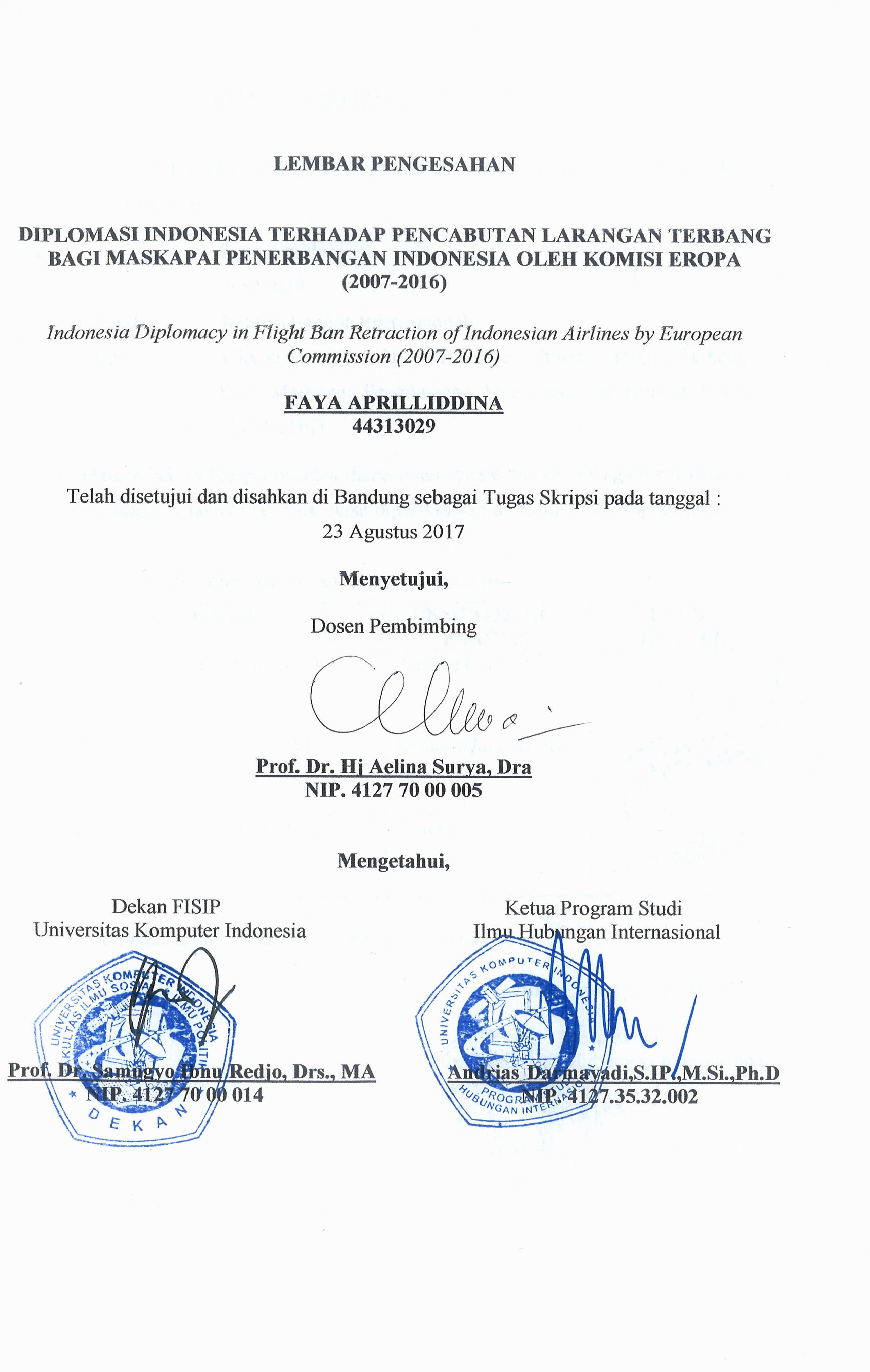 Image
UNIKOM_44313029_FAYA APRILLIDDINA_LEMBAR PENGESAHAN.jpg
Download (807kB)
 Image
UNIKOM_44313029_FAYA APRILLIDDINA_SURAT KETERANGAN PERSETUJU.jpg
Download (2MB)
Abstract
Since 2012 tourists from China became the main source of world tourism market which continues to experience tremendous growth. Chinese tourists form a sizeable consumer group and recognized as the largest and most profitable shopper in the world. Since the turn of the 20th century, there has been a rapid increase in the number of overseas trips made by Chinese tourists from 10 million people traveling to other countries in 2000, to more than 100 million in the current period. The high number and expenditure of Chinese tourists, become a fascination and a battle for each country to attract tourists from China, including Indonesia. However, the potential Chinese tourists have not been able to maximize by Indonesia until now. The number of arrival Chinese tourists to Indonesia is still very small when compared with other ASEAN countries such as Thailand, Singapore and Malaysia which can attract more Chinese tourists to the country. Therefore, in order to increase the number of Chinese tourists visit, Indonesia is seeking Multitrack Diplomacy involving various parties through First Track Diplomacy, Second Track Diplomacy, Third Track Diplomacy, Fourth Track Diplomacy, Fifth Track Diplomacy and Ninth Track Diplomacy. Considering there is a high income potential that Indonesia can get from China's tourist visits to Indonesia. The Methods in this research use qualitative methods. Much of the data was collected from literature studies, website tracking, and from interviews with the Directorate for Asia Pasific Tourism Promotion Deputy Minister for International Marketing, Ministry of Tourism. The results showed that Indonesia�s diplomacy through Multitrack Diplomacy, succeeded in increasing the number of Chinese tourists visit to Indonesia, but the number is still small compared to other ASEAN countries.
Since 2012 tourists from China became the main source of world tourism market which continues to experience tremendous growth. Chinese tourists form a sizeable consumer group and recognized as the largest and most profitable shopper in the world. Since the turn of the 20th century, there has been a rapid increase in the number of overseas trips made by Chinese tourists from 10 million people traveling to other countries in 2000, to more than 100 million in the current period. The high number and expenditure of Chinese tourists, become a fascination and a battle for each country to attract tourists from China, including Indonesia. However, the potential Chinese tourists have not been able to maximize by Indonesia until now. The number of arrival Chinese tourists to Indonesia is still very small when compared with other ASEAN countries such as Thailand, Singapore and Malaysia which can attract more Chinese tourists to the country. Therefore, in order to increase the number of Chinese tourists visit, Indonesia is seeking Multitrack Diplomacy involving various parties through First Track Diplomacy, Second Track Diplomacy, Third Track Diplomacy, Fourth Track Diplomacy, Fifth Track Diplomacy and Ninth Track Diplomacy. Considering there is a high income potential that Indonesia can get from China's tourist visits to Indonesia. The Methods in this research use qualitative methods. Much of the data was collected from literature studies, website tracking, and from interviews with the Directorate for Asia Pasific Tourism Promotion Deputy Minister for International Marketing, Ministry of Tourism. The results showed that Indonesia�s diplomacy through Multitrack Diplomacy, succeeded in increasing the number of Chinese tourists visit to Indonesia, but the number is still small compared to other ASEAN countries.
| Item Type: | Thesis (Other) |
|---|---|
| Additional Information: | Migrasi dari GDL. Identifier: jbptunikompp-gdl-fayaaprill-37870. Folder: S1-Final_Project / Fakultas_Sospol / Hubungan_Internasional / 2017 |
| Uncontrolled Keywords: | Since 2012 tourists from China became the main source of world tourism market which continues to experience tremendous growth. Chinese tourists form a sizeable consumer group and recognized as the largest and most profitable shopper in the world. Since the turn of the 20th century, there has been a rapid increase in the number of overseas trips made by Chinese tourists from 10 million people traveling to other countries in 2000, to more than 100 million in the current period. The high number and expenditure of Chinese tourists, become a fascination and a battle for each country to attract tourists from China, including Indonesia. However, the potential Chinese tourists have not been able to maximize by Indonesia until now. The number of arrival Chinese tourists to Indonesia is still very small when compared with other ASEAN countries such as Thailand, Singapore and Malaysia which can attract more Chinese tourists to the country. Therefore, in order to increase the number of Chinese tourists visit, Indonesia is seeking Multitrack Diplomacy involving various parties through First Track Diplomacy, Second Track Diplomacy, Third Track Diplomacy, Fourth Track Diplomacy, Fifth Track Diplomacy and Ninth Track Diplomacy. Considering there is a high income potential that Indonesia can get from China's tourist visits to Indonesia. The Methods in this research use qualitative methods. Much of the data was collected from literature studies, website tracking, and from interviews with the Directorate for Asia Pasific Tourism Promotion Deputy Minister for International Marketing, Ministry of Tourism. The results showed that Indonesia�s diplomacy through Multitrack Diplomacy, succeeded in increasing the number of Chinese tourists visit to Indonesia, but the number is still small compared to other ASEAN countries. |
| Divisions: | S1 Skripsi > Hubungan Internasional |
| Depositing User: | Robot Migration |
| Date Deposited: | 05 Nov 2026 12:48 |
| Last Modified: | 05 Nov 2026 12:48 |
| URI: | https://elibrary.unikom.ac.id/id/eprint/48766 |
Actions (login required)

- View Item